
Mechanical stress, vibration, and noise are some common phenomena of machinery. These phenomena may create problems in the later stages of machining processes. Mechanical stress may lead to fatigue failure and deformation. On the other hand, vibration may lead to machine parts misalignment, damage to bearings, and more. Consequently, noise may lead to increased wear & tear, reduced efficiency, and communication issues. So, we can realize the consequences of these three phenomena of every machinery. To mitigate such problems, the rubber sheet is used.
Rubber sheets are often used in many industrial & workshop activities. They are versatile, which means we can find their extensive applications in various fields. Besides, the rubber sheet is crucial in temperature & weather control and chemical exposure. Since they are made of rubbers, they offer unique properties that make them suitable for these sectors. Well, the properties we get from rubber sheets are typically the properties of various rubber types. For example, EPDM, neoprene, NBR, and silicone are noteworthy.
Therefore, the significance of understanding the fundamentals of a rubber sheet is extensive. Thus, this article aims to highlight different types of rubber sheets and their unique applications. We hope this article can help you make an informed decision when choosing the right product. Let’s explore more.
What is a rubber sheet?
A rubber sheet is a popular material known for its elastic properties. They are typically composed of natural or synthetic rubber polymers. Natural rubbers normally come from the latex sap of rubber trees. On the other hand, synthetic rubber comes from various complex chemical processes. For example, EPDM, Neoprene, NBR, and silicone rubbers are noteworthy. FYI: For industrial uses, synthetic rubber sheets are more popular than natural rubber sheets.
The manufacturing process of a rubber gasket sheet is simple. Although, we obtain rubber sheets in three main ways: calendaring, extrusion, and press holding. Well, calendering is the most popular manufacturing process for rubber sheeting.
Calendering is also a continuous production process. Heavy rollers usually do the shaping process. During calendaring, the rubber material undergoes controlled pressure & temperature. This is necessary to achieve uniform thickness, smooth surface, and specific physical properties. Therefore, this production process ensures high quality with precise dimensions & consistent characteristics.
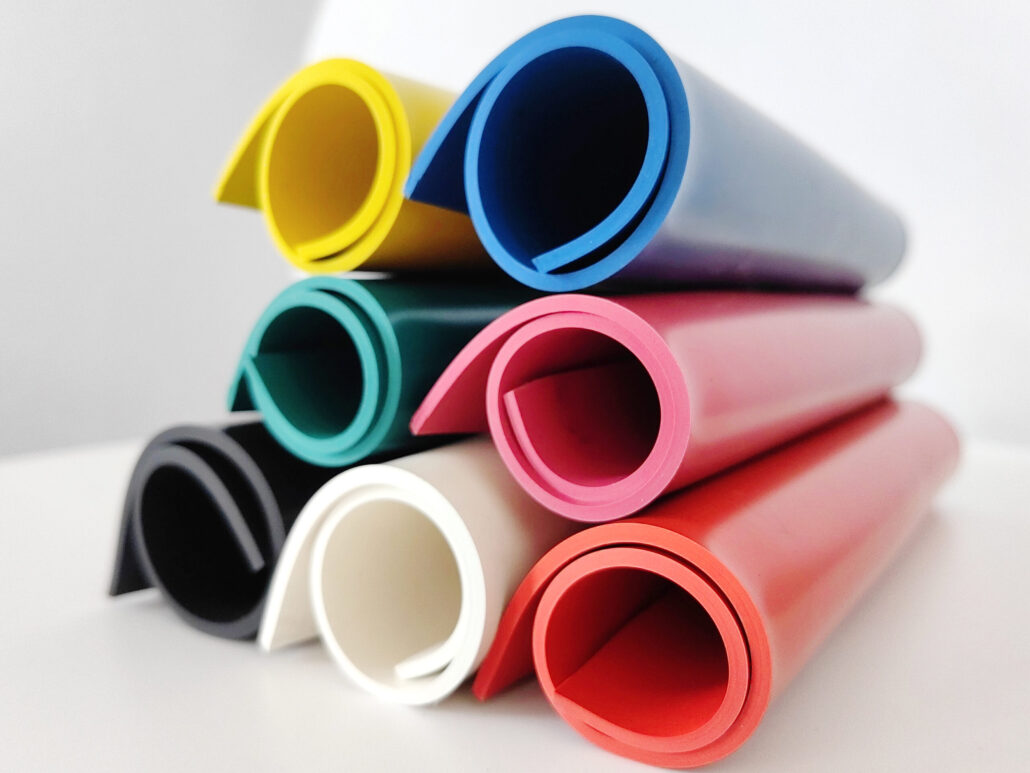
Benefits of Rubber Sheets
A rubber sheet is usually made for unique purposes due to its multiple advantages. These benefits make rubber sheeting indispensable in various industries. Let’s check out some of its primary benefits.
- Shock Absorption: The rubber sheet is primarily known for its excellent shock absorption ability. It makes them ideal for applications where impact resistance is important. Rubber sheets can effectively dampen vibration and minimize the transmission of shocks.
- Anti-vibration: The elasticity of the rubber is responsible for dampening the vibration. This property of rubber absorbs and dissipates vibration. As a result, it can effectively reduce noise and prevent oscillation transfer.
- Resistance: Rubber sheets are excellent for insulating electricity. As a result, we may often find their applications in electrical industries. Besides, a rubber sheet can also prevent rust and discolourization. Therefore, it ensures its structural integrity and aesthetic appeal over time.
- Weather resistance: Rubber sheets like EPDM & silicone rubber offer excellent weather resistance capabilities. They can withstand exposure to sunlight, rain, and extreme temperatures. As a result, they are a preferred choice for outdoor applications. Typical applications include roofing materials and seals.
- Resistance to chemicals: Rubber sheets can also withstand acids, bases, and oils. This chemical resistance ability usually extends the lifespan of the material. Consequently, it also ensures its reliability in diverse industrial settings.
- Durability & longevity: The benefits mentioned above prove that rubber sheets are durable. Therefore, a high-quality rubber sheet can offer you a longer lifespan. You know, it ultimately reduces the need for replacement.
Wide Application of Rubber Sheets (Popular 10 Applications)
We have already gone through the benefits offered by a rubber sheet. We can realize that these benefits make them popular in a wide range of applications across various industries.
- Gaskets are prevalent in preventing leaks. They ensure the integrity of various mechanical systems.
- Seals are also prevalent in effective sealing equipment in machinery. They help prevent leakage of fluids & gases. Overall, they maintain the efficiency and safety of the applied systems.
- Rubber sheets also have extensive applications as a protective barrier in construction sites. You may consider moisture, chemical, or physical impacts as a threat. Well, for most protection uses, rubber sheets are widely used.
- Vibration Pads are prevalent for dampening vibrations in machinery & equipment. This application is crucial in maintaining stability & reducing noise in various industrial applications.
- Flooring & Roofing uses can be seen in various places. We may often use rubber sheets for flooring in sports courts, dance, yoga & martial arts rooms. On the other hand, we often use rubber sheets in automotive or household roofs.
- Electrical Insulation: Rubber sheets often protect people against electrical shocks.
- Yoga Mats: A rubber sheet’s soft & cushioning nature makes it ideal for making yoga mats.
- Footwear: Rubber sheets are also prevalent in manufacturing shoe soles.
- Protective mats: In industrial and commercial settings, rubber sheets are used for protection. They use it to protect against heavy equipment, chemicals, and wear.
- Soundproofing: Rubber sheet’s microscopic pores typically reduce noise levels. Therefore, we often find its use in various musical theatres, practice, or recording rooms.
Types of rubber sheets
A wide range of rubber sheet types can be found in many applications. The reason behind this variety is the diversity of applications. Some applications may require high-temperature resistance, while some require outdoor uses. Some applications require budget-friendly rubber sheets, while some require durability. Therefore, to meet all these requirements, the types of different rubber materials appear. Consequently, based on different rubber materials, we can divide rubber sheets into eight primary types.
Type#1 EPDM Rubber Sheets
EPDM stands for Ethylene Propylene Diene Monomer. EPDM rubber sheets are ideal for weather resistance and high-temperature applications. Typical applications can be seen in automotive, construction, and HVAC systems. EPDM sheet also offers excellent durability, UV resistance, and chemical compatibility. Therefore, they are primarily ideal for outdoor applications.
Type#2 NBR Rubber Sheets
NBR stands for Nitrile Butadiene Rubber. NBR rubber sheets are also known as Nitrile rubber sheets. This rubber sheet type is especially suitable for oil & fuel resistance. NBR rubber sheets are used to make various gaskets and seal manufacturing, like O-rings. Another benefit of NBR rubber sheets is their flexibility.
Type#3 Neoprene Rubber Sheet
A neoprene rubber sheet is another versatile elastomer popular for its synthetic composition. Its polymerized chloroprene structure features flexibility, resilience, and a wide operating temperature range. Similar to EPDM, this type of rubber sheet is also ideal for use in outdoor applications. The physical toughness of neoprene offers longevity, and flame resistance provides safety.
Type#4 HNBR Rubber Sheets
HNBR stands for Hydrogenated Nitrile Butadiene Rubber. It is a specialized rubber that comprises hydrogenated bonds. Compared to NBR, it offers enhanced resistance to heat, chemicals, and wear. Therefore, HNBR rubber sheets are widely popular in the automotive, oil, and gas industries.
Type#5 FKM Rubber Sheets
Fluoroelastomer or FKM rubber sheets are known for their unique properties. The composition contains fluorine. As a result, it can offer enhanced resistance to temperature and excellent chemical stability. Therefore, we often find it in the automotive, aerospace, and semiconductor industries. FKM rubber sheet comes in various colours. For easy identification, you can customize the colours per your requirements.
Type#6 Foam rubber sheets
Foam rubber sheets are made from elastic materials mixed with foaming agents. The result comes with a porous structure. This specialized structure offers spongy texture and flexibility. Well, they offer cushioning, insulation, packaging, noise reduction, lightweight, and shock absorption. Foam rubber sheets are prevalent in aerospace, automotive, sports, and other applications.
Type#7 Silicone Rubber Sheets
Silicone rubber sheets are normally composed of silicon-based polymer. This rubber composition especially boasts distinctive features. Silicone sheets are both resistant to high and low temperatures. As a result, we often find them in the medical and food industries. Besides, the silicone rubber sheet also provides superior electrical insulation. Therefore, they find use in electronic components and power systems.
Type#8 Silicone Sponge Sheets
Silicone sponge sheets are also popular for combining silicone polymers and a porous structure. This combination provides a lightweight and flexibility. Besides, silicone sponge sheets also offer resilience and compressibility. Their open-cell structure allows for effective sealing & cushioning. These rubber sheets have extensive applications in HVAC, construction, and automotive gaskets.
FAQ
Q1. Is rubber sheet waterproof?
Answer: Yes, rubber sheets are waterproof. Certain materials like EPDM and silicone are excellent for water resistance.
Q2. What is the difference between NRB and HNBR rubber sheets?
Answer: NBR and HNBR differ in their hydrogenation levels. Compared to NBR, HNBR is more saturated and offers enhanced heat and chemical resistance.
Q3. What is the difference between FKM and Viton?
Answer: FKM is a general term for fluoroelastomeric compounds. On the other hand, Viton is a specific brand of FKM. Viton is popular for its high chemical resistance and temperature tolerance. As a result, it is suitable for various demanding applications.