
In this competitive manufacturing world, making the right decision is challenging. Especially when we consider choosing mechanical, electrical, and automated machines. We know that a wise decision is always necessary for success. Therefore, before purchasing a laser welding machine, we must carefully evaluate its parameters. And that is what we are going to talk about today.
How To Choose the Right Laser Welding Machine?
In the following, we have highlighted five important sections that describe how to choose the right device. We hope these sections help you find the right equipment for your job.
Why Choose a Laser Welding Machine?
We all know that laser devices are incredibly faster than mechanical ones. You know it uses a high-power laser beam to mark, etch, cut, engrave, or weld any metals. Since it uses laser beams as the medium, they are fast, efficient, and productive. So why not a laser welding machine? Although it has an initial upfront cost, yet you can get efficient results for the long-term application. It actually reduces the overall cost of your production.
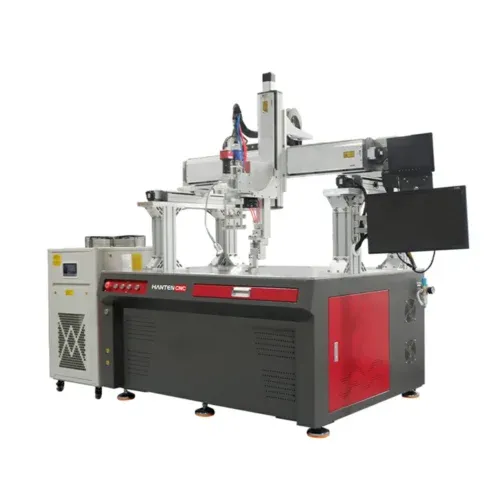
There are other reasons why you should choose a laser welding machine. You know it is a non-contact process. Therefore, the laser welding process is safe. If you choose automatic laser welding machines, they are even safer. Because of these benefits, laser welding machines are prevalent across diverse industries.
Pulsed Or Continuous Laser?
When choosing the right laser welding machine, we must choose the right type. Continuous waves and pulsed waves are two general forms of various laser types. The following table shows that a continuous wave is often found in fiber laser welders. Conversely, pulsed waves are often seen in Nd: YAG lasers.
Now, when choosing between them, first evaluate your application requirements. Check for more material thickness, desired weld penetration, and the need for minimal thermal impact. These factors are necessary to choose the right laser welding machine for your application.
| Continuous wave (CW) Laser welders | Pulsed Wave (PW) Laser welders |
| Constant & uninterrupted laser welding | Interrupted at a certain width & frequency |
| Usually found in Fiber & CO2 laser devices | Usually found it Nd: YAG laser devices |
| Suitable for deep penetration laser welding; over 1.5mm is possible | Particularly well-suited for materials with thin walls and equipment that is sensitive to heat |
| Ideal for the welding of materials that are prone to cracking, such as high-carbon stainless steel | Suitable for reflective metals |
| Consumes higher power energy | Consumes lower power energy |
| Lower precision & control | Enhanced precision and control |
| Creates more heat-affected zones than PW laser welders | Creates less heat-affected zone than CW laser welders |
Fiber Laser Vs CO2 Laser Vs. Nd: YAG Laser
Laser welding needs laser with high energy density, precise focusing, and suitable wavelengths. They are necessary for optimal material absorption & penetration. As we can see, three types of lasers are popular for laser welding. Concerning suitability, we can compare them with a few factors.
The fiber laser produces sharp and thin beams. Therefore, it provides continuous and penetrative operations for general welding applications. A similar nature can be observed in CO2 laser welders as well. What sets them apart is the efficiency. Fiber lasers offer a maximum efficiency of 30%. On the other hand, a CO2 laser offers a maximum efficiency of 10%.
Although, Nd: YAG is less common in laser welding. Yet we can find its applications in the automotive industry’s blank welding of aluminum alloys. For general-purpose applications, a fiber laser welder is seen more often.
| Criteria | Fiber Laser Welder | CO2 Laser Welder | Nd: YAG Laser Welder |
| Technology | Sharp & thin beams allow penetrative job | Using gas mixture to ensure continuous job | Effective power control, duration, and shape |
| Material thickness | Can penetrate thick sheets with great speed | Can penetrate thick sheets with great speed | Optimized for pulsed mode |
| Power Consumption | Good | Poor | General |
| Beam Quality | Excellent | Good | General |
| Average Efficiency | 25% to 30% | 7% to 10% | 3 to 4% |
| Lifespan | 100,000 hours | 20,000 hours | 3,000 hours |
| Initial Cost | Expensive | Cheaper | Relatively Expensive |
Parameters To Be Checked: Control & Adjustment Features and Monitoring
Once you have considered the type of lasers, it is time to check for other device parameters. Control & adjustment features and monitoring are two basic areas you must focus on. These two features play the most important role in effectively using laser welding machines. Well, control & adjustment allow you to fine-tune a laser welder according to the project requirements. The following four specifications that you must check in control & adjustment features are:
- Power settings determine how your device can handle various materials and thicknesses. Fine-tuning power levels ensures optimal welding performance.
- Pulse Frequency & duration determine how your device manages heat input and avoids distortion. This is important to know when working with delicate or heat-sensitive materials.
- Beam focus & spot size determine how accurately your laser welder can perform.
- Welding speed, you know, determines the productivity of your laser welding machine.
On the other hand, monitoring capabilities also contribute to precision & quality during welding. This feature involves measuring temperature, energy input, and weld penetration depth. These monitoring features enable you to discover and handle possible problems quickly. It is obvious that these features can minimize the risk of defects. Overall, they can enhance the overall quality of the weld.
Manual Vs. Semi-Automatic Vs. Automatic Laser Welding: Which Is Better?
When selecting the right laser welding machine, another criterion we must focus on is the nature of the operation. Is it manual, semi-automatic, or automatic? Which method suits your applications? Each has unique advantages and limitations. For example, a manual laser welder or hand laser welding machine can work with all general-purpose works. On the other hand, automatic laser welding allows you to do batch production.
Therefore, choosing the right laser welding machine (manual or automatic) depends on you. More specifically, it depends on the application’s requirements, production volume, and precision level.
| Criteria | Manual | Semi-automatic | Automatic |
| Precision | Moderate to high based on the skills of the operator | High | Very high |
| Speed | Medium | Fast | Very Fast |
| Skill Level | High | Moderate | Low to moderate |
| Consistency | Depends on operator’s skills | Improved consistency | High consistency |
| Programming | No need | Pre-programmed sequences | Automated programming |
| Flexibility | Limited flexibility | Improved flexibility | High flexibility |
| Cost | Low upfront cost | Moderate upfront cost | High upfront cost |
Where Do You Plan to Put the Laser Welder to Use?
After considering all the parameters, here we are at the final stage. You know, the application determines the correct type of laser welding machine. This step requires careful evaluation of the specific needs of the intended application. It is obvious that this evaluation can help you make the right choice and, consequently, ensure optimal performance.
Handheld Laser Welding Machines
These are general-purpose laser welding machines. Handheld laser welding machines are ideal for applications that require remote applications. It means mobile applications like in workshops, construction, and repair. In Hanten CNC, you can get a variety of handheld laser welding machines.
Jewelry Laser Welder
Undoubtedly, these devices require precision. They are not the ones that deal with thick materials. Jewelry laser welders are specifically designed to handle intricate Jewelry applications. What you should focus on in these laser welders is their monitoring features.
Electronics Laser Welder
Here is another heat-sensitive application. It also requires precision laser welders. What matters in these places are HAZ (heat-affected zone), pulse control, and energy management. Moreover, you also should focus on the machine’s ability to weld small, sensitive components.
Laser Welding in Automotive Industry
This industry deals with high-strength materials and intricate structural components. Therefore, you need a laser welder that is capable of dealing with such applications. In this case, consider the machine’s power output and beam quality. And most importantly, check the device’s capability to ensure strong & durable welds.
How Much Does a Laser Welder Cost?
The cost of a laser welder depends on machine type, power, brand, and additional features. Budget-friendly considerations vary across industries. For example, applications requiring precision, like in aerospace, demand more advanced models. On the other hand, smaller-scale applications might opt for cost-effective alternatives. Check out the following table for more ideas about a laser welder price.
| Laser welding machine | Focus Specification | Price |
| Handheld laser welding machine (3 in 1) | 1500W | $5,400 to $8,700 |
| Handheld laser welder (3 in 1) | 1000W, 2000W, 3000W | $4,500 to $10,800 |
| Laser welding machine (3 in 1) | 3000W | $8,600 to $10,400 |
| Laser welding machine for lithium-ion batteries | 1500W, 2000W, 3000W | $16,500 to $21,500 |
| Articulated arm mold laser welder | 1000W, 1500W | $10,300 to $12,700 |
| Galvanometer fiber laser welding machine | 1500W, 2000W, 3000W | $16,000 to $21,000 |
| 3-axis automatic laser welding machine (XYZ) | 1000W | $9,580 to $29,800 |
| Small batch battery weld repairs | 1500W | $6,900 |
| Jewelry laser welding machine | 100W | $3,500 |
| Desktop laser welder for jewelry | 200W | $3,500 to $5,066 |
| Fixed beam path YAG laser welding machine | 200W, 400W | $5,100 to $7,500 |
| Large working area laser welder for advertising word | 300W | $4,800 to $8,000 |
Conclusion
Based on the preceding explanation, we can now make informed decisions when selecting laser welding machine. We are able to determine what parameters we need to concentrate on. If you have any queries about how to choose an appropriate laser welder, don’t hesitate to get in touch with us. We offer a large collection of different kinds of laser welding machines. And these machines are ideal for a variety of applications. As a result, you will have a wide range of options for your particular application.